
Topic 3: NAVIGATING THROUGH TURBULENT TIMES: EQUITY STOCK PORTFOLIO
The recent volatility in the markets has impacted your stock portfolio significantly. You see, some of the stocks you hold in your portfolio have fallen
substantially. You also see that some of the companies you liked earlier, which were too expensive, are now better priced.
Some of the dilemmas you face now are:
1. Do I stay put?
2. Sell everything and stay out?
3. Sell a few and buy other stocks?
The even bigger question here is, how do you know if a stock you own needs replacement, or should you continue to hold?
Consider the following scenario, the stock you own has gone up 50% from your purchase price in the recent past. Given the market volatility, it has now corrected and reached back to your original buying price. You believe that the price will go back to its peak once the crisis is over. You also fear that the price may correct further, and you could be losing your capital, again, leaving with you a dilemma on what to do next.
1. The bottom-up stock-picking strategy helps you invest in fundamentally sound businesses that are expected to grow in the future. Based on the investment style of the manager, he could choose value or growth companies
2. The manager brings sector orientation to your overall stock portfolio. If a particular trend/sector has started to gain traction, the manager may realign the portfolio to benefit from the same. However, while managing our personal stock portfolio, we seldom fail to look at overall sector allocation
3. Most of these funds are managed as multi-cap portfolios, thereby giving managers the flexibility to invest in the most attractive segment of the market
4. Strategically add some revival/contrarian stories
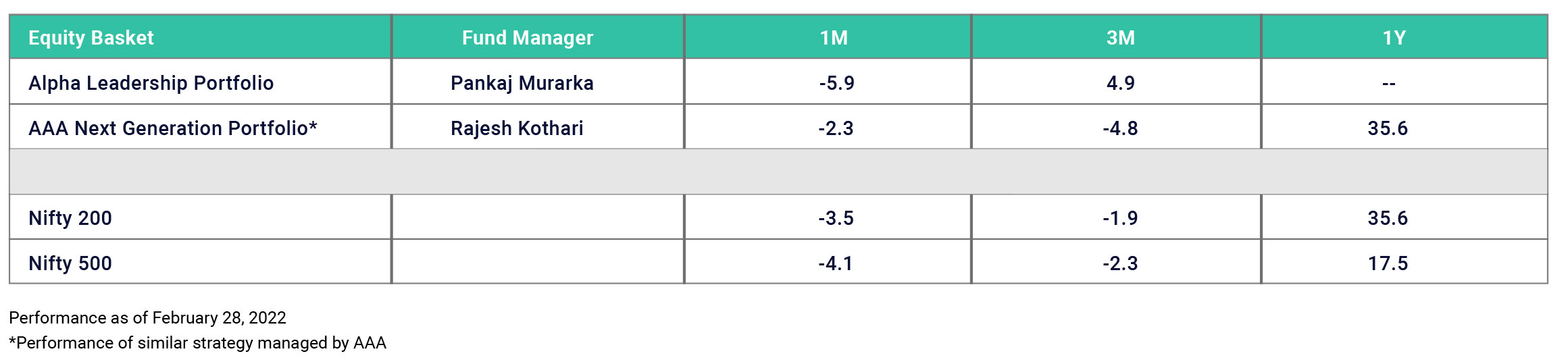
While it may be impossible to look at various aspects of portfolio management while directly investing in stocks, we believe it is best left to professional fund managers. Thereby, to add value proposition to your overall portfolio, we have two equity baskets (stock portfolio) managed by professional managers in the offering.
Some of the dilemmas you face now are:
1. Do I stay put?
2. Sell everything and stay out?
3. Sell a few and buy other stocks?
The even bigger question here is, how do you know if a stock you own needs replacement, or should you continue to hold?
Consider the following scenario, the stock you own has gone up 50% from your purchase price in the recent past. Given the market volatility, it has now corrected and reached back to your original buying price. You believe that the price will go back to its peak once the crisis is over. You also fear that the price may correct further, and you could be losing your capital, again, leaving with you a dilemma on what to do next.
1. The bottom-up stock-picking strategy helps you invest in fundamentally sound businesses that are expected to grow in the future. Based on the investment style of the manager, he could choose value or growth companies
2. The manager brings sector orientation to your overall stock portfolio. If a particular trend/sector has started to gain traction, the manager may realign the portfolio to benefit from the same. However, while managing our personal stock portfolio, we seldom fail to look at overall sector allocation
3. Most of these funds are managed as multi-cap portfolios, thereby giving managers the flexibility to invest in the most attractive segment of the market
4. Strategically add some revival/contrarian stories
While it may be impossible to look at various aspects of portfolio management while directly investing in stocks, we believe it is best left to professional fund managers. Thereby, to add value proposition to your overall portfolio, we have two equity baskets (stock portfolio) managed by professional managers in the offering.